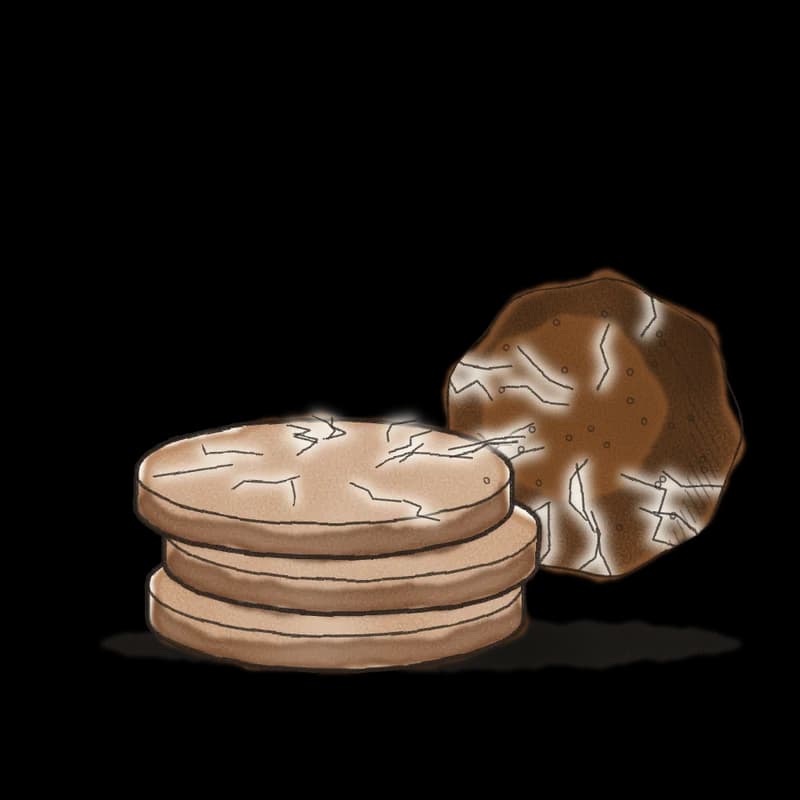
Nana Ruth's molasses crinkle card has a coffee ring right over the spice list. Flour, soda, salt, cinnamon and ginger are all clear. The amount of cloves sits under the stain. Any modern model, shown that card, would happily tell you it says "1/2 tsp." It is the most common amount in recipes like it. It is very probably right.
Kitchenlore will not write "1/2 tsp." It writes [hard to read], in that exact spot, and lists it under the recipe for the family to fill. People sometimes ask us why we are so stubborn about this, when a guess would be faster and usually correct. This post is the answer.
A guess becomes a fact the moment it is printed
A family cookbook is not a search result. It gets printed, handed down, quoted at Thanksgiving. Once "1/2 tsp." is set in type next to the rest of Nana's handwriting, nobody will ever know it was a guess. The next generation will cook it that way and say that is how Nana made it. If she actually used a whole teaspoon, because she liked them spicy, that piece of her is gone, replaced by an average.
That is the problem with a likely guess. It is likely because it is typical, and family recipes are worth saving precisely because they are not typical. The odd amount, the strange extra step, the ingredient nobody else uses: those are the things a model is most likely to smooth away.
Who should fill the gap
Someone in the family very often knows. An aunt who baked with Nana every Christmas remembers the cloves. A brother remembers that the card says "Crisco" under the smudge because he was there when it got wet. So when a spot is marked [hard to read], anyone with the contribute role on the book can fill it from memory.
Every fill is signed with the name of the person who made it and set in a different mark from the original. Read the recipe and you see both things at once: what the card says, and what Karen remembers. That is a more truthful book than one where the software quietly decided for everybody. It is also, we think, a better one. The fills become part of the story.
The same rule for words
The rule is bigger than smudges. Kitchenlore never invents anything: no ingredients, amounts, steps, times, names, dates, stories or feelings that are not in the source. The "In her words" notes on every recipe go further. Every quote is checked against the original card, memo or text, word for word, by plain code rather than a model. If a quote is not in the source, it is dropped. We do not reword it to fit, tidy the grammar, or translate it.
Language models are very good at producing warm, plausible sentences. That is exactly what we cannot allow near a grandmother's words. A plausible line attributed to someone who is no longer here to say she did not say it is not a small error. It is putting words in her mouth. So we built the product so that it cannot happen quietly: the models read, and the checks make sure they stay honest.
What it costs us
Honesty has a price. Some recipes come back with more [hard to read] marks than people want, especially from faint pencil or a noisy memo. A competitor that fills every gap will look more impressive in a demo. We are fine with that. A sharper photo fixes many marks (we wrote a guide), and the family fixes most of the rest.
Sometimes nobody remembers. Then the mark stays, in the app and in the printed book. We think that is right. A small honest gap says: here is where the card was loved too hard. That is part of the recipe too.
- Unreadable spots are marked [hard to read], never guessed
- Any contributor can fill a spot from memory, signed with their name
- Fills look different from the original, in the app and in print
- Quotes are checked word for word against the source, and dropped if not found